Andrew Crawford FRPS
- Chris Hilton

- Jan 14
- 4 min read

It all started with a SupaSnaps Snappit and a work trip to West Africa where our current club chair, Andrew Crawford, took pictures that were important ... important because in the days of film, and more particularly, in the hands of an amateur with only twenty or thirty frames available for the whole trip, you really thought about what you pointed the camera at. You took photographs that meant something to you, or that were going to be used to help describe the place or event to loved ones at a later date.

There was an urgency to those pictures that became known as the 'snapshot aesthetic', frequently looked down on but, now, enjoying a rennaisance in places like The People's Archive.
Andrew got the bug so he went along to Colin's photography evening classes to learn more. And it was there that that thing happened, that thing that we see in so many classes and clubs up and down the country ... where your images start to get better in terms of composition and control but they start to lose the soul that was so evident in those early, promising snaps!
And so, years later, safe in the knowledge that he had graduated at the top of Colin's class, Andrew went along to the Royal Photographic Society to see if he could progress through their distinctions programe. He took prints of his carefully crafted images, to be told that whilst they showed a technical skill that left no doubt that Andrew could work his way round the twiddly bits on a camera ... the images just didn't say anything. Tough but true! Taking that onboard was the start of his progression as a photographer ... a lot of people stop at the point of technical excellence but that's just learning your craft ... 'art' is what you do with it.
After concentrating on what the society would call his 'visual narrative' (and I would call injecting a bit of soul back into your work), Andrew passed his Licentiate. It was whilst looking in the RPS magazine to see his name in lights that Andrew came across Tony Bramley (a previous speaker at our club) and Susan Hendrick (a former member of our club) and that got him thinking that not only could photography be descriptive but it could be creative and evocative. This led Andrew to start experimenting and exploring different techniques, and as he was taking a new direction he thought he'd gauge how it was going by entering the 2018 Chaiya Art Awards ... and he did well ... both a finalist and an exhibitor.

The next light bulb moment came after a hospital visit which left Andrew, temporarily, struggling to see very well. He became fascinated with how little information the brain needed in order form a meaningful image ... he decided to recreate what he was seeing ... and an Associate Panel was born.
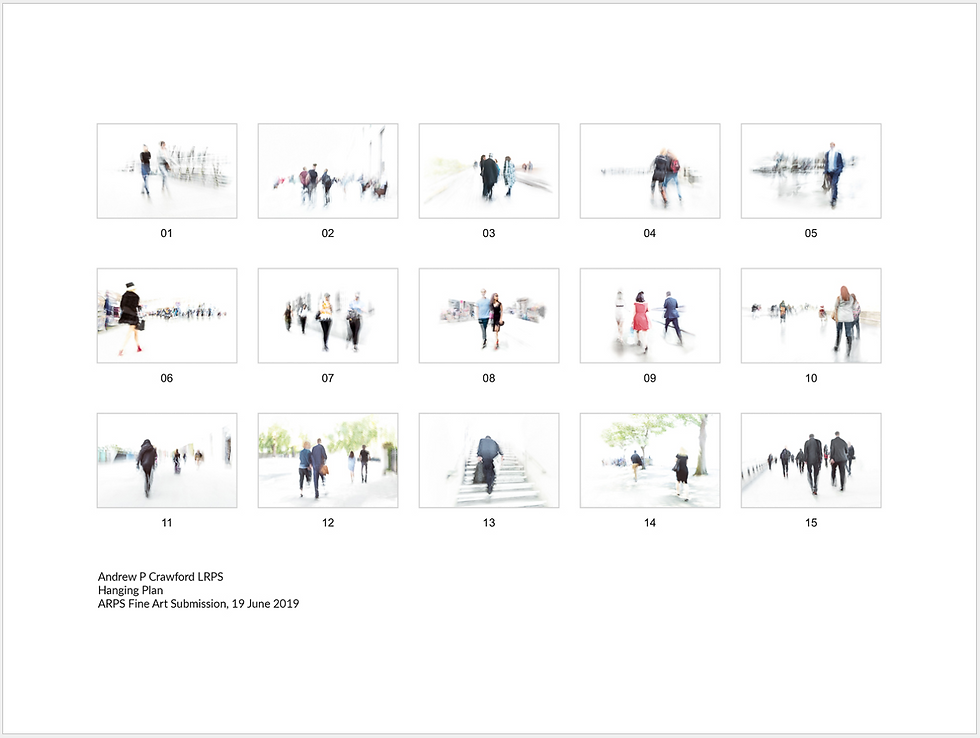
You can view these as larger images on Andrew's website ...
Life was busy after that, Covid came to visit us all and there was a move to the Westcountry, a three month renovation that the builders managed to take two and a half years to complete but all the time Andrew was thinking about the project that would gain him a Fellowship. There were a few projects and ideas along the way that didn't quite get him over the line ... "What Colour is a trip to the bank?" or the fascinating "Landscapes in Six Pixels", but in the end it was a bout of Covid that provided the inspiration.
A bout of Covid that left him languishing in a Bordeaux hotel, staring at the walls ... going stir crazy with no wifi, no TV and nothing to do but stare at the imperfections in the walls and ceilings of the sparsely decorated room, wondering what images he would make if he could drag himself from his pit.
And later, he decided to recreate that experience by seeking out details in his own home that would ordinarily elude the viewer ... details that might not be noticed in a mere glance or from a distance. High key monochrome images that would invite intimate inspection.
Imagine the scene at the Royal Photographic Society when twenty of Andrew's images were presented to the assessors as two rows of ten white squares!
From the viewing distance of two metres, they were completely devoid of detail ...
It was only when they got up close, that the cracks, the irregularities in the plaster, the brush strokes from the paint. Marks, stains, textures ... the more you looked ... the more you saw.
And it was that intimate inspection that allowed the assessors to to see what it was like, lying in that isolated bed, staring at four white walls ... although ... I can't help but wonder, if Andrew was also thinking, just a little bit, about that bloody building job and the snagging list ...
Join us for our next speaker over zoom ... non members welcome ...