
White eggs and Upton Park

Graham Herbert’s home studio, 11 March 2026
Photography’s been part of your life for as long as you can remember. The outdoors and landscape your thing. So, what do you do when Covid comes along and we’re all locked inside? You could photograph the walls of your prison or point your lens wistfully out the window; you might buy or borrow a dog to photograph and/or provide an excuse for a limited outside meander each day; or you could, like club member Graham Herbert, build your own studio in a 5’x7’ corner of your work room, fettle a few lighting modifiers, and set about teaching yourself Still Life photography.
It was on the one day a week photography course that was part of his graphic design degree that Graham first came to understand the importance of, and properties of, light in making an image; its reflection, refraction and absorption; its ability to reveal form; to convey mood; to render three dimensions on a two dimensional sheet of photographic film or paper. And it’s at college perhaps that a love of things round was born, in an exercise in photographing a white egg on a textured white background.

It’s their use of light that has drawn Graham to emulate, on a small scale, the cinematic style and set building of his photographic heroes: Gregory Crewdson and Erwin Olaf, and the moody lighting of Netflix series and prequel to Breaking Bad: Better Call Saul.
Graham took us through different styles and approaches to still life. He showed us Classic set ups: fruit staged with treen and kitchenalia from an ever-growing collection sourced from charity and junk shops. We saw arrangements of old tools, of scales and parcels and feathers.
Then morphing those ideas into more contemporary approaches: a homage to Ken’s Cafe at Upton Park; good and bad Santa, and; a tribute to his father’s shed complete with car magazine and pin up.
Each with a set designed, built and lit by Graham is his home studio.
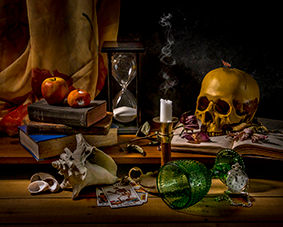
We learnt about Vanitas, an art genre of memento mori, symbolising the transience of life, the futility of pleasure, and the certainty of death.
And not only what Chiaroscuro lighting is but also a masterclass in the pronunciation of a word that evades many tongues.
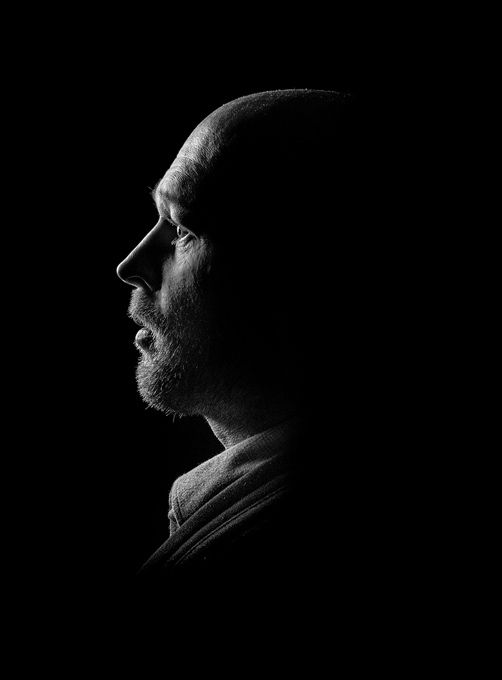
Then taking it to the next level in Tenebrism with its even stronger contrasts of light and dark, faces picked out against a dark background.
Graham showed us Flat Lays – images taken from above but still lit to reveal texture and form. All brought alive with controlled light, a limited colour palette (itself a challenge as Graham is partially colour blind) and a career’s worth of understanding of design.
And then there’s glass: glass with its reflection, refraction and transmission of light, glass with its shapes and contours, and of course round glass balls.
Graham had brought along some glassware and gave us a live demonstration of light painting using a small handheld light wrapped in coloured tissue and bubble wrap to colour and diffuse its light. Using the Live-Comp mode that is almost unique to Olympus cameras, we were able to see the light painted image as it was being built. A few of us volunteered to have a go. This is some of what we produced
Amazing what you can do in a small space with some patience and some light!
Join us on April 1 at the Arts Centre for something different again - tickets for non-members are available from the Bridport Arts Centre website.


