
Landscape ... the Long Version

In all the years I've been going to the club, we have never, as a group, explored what a landscape photograph actually is. It is very easy to assume that it is an image with lots of green stuff and some nice light, and whilst an image like that is, undoubtedly, the mainstay of landscape photography ... we found that it doesn't just stop there!
But that is where we are going to start ... with the work of Ansel Adams ...

This has all the elements you would expect to find in a landscape photograph. There is foreground interest provided by the silhoettes of the tree, a leading line in the form of the river to take you though the midground before alighting in the dramatic background.
Full of mood, full of light, full of drama ... it speaks of natures majesty ... the virgin West, unsullied by man, except for, what looks to me, like a small jetty protruding into the river at the bottom of the image.
Ansel Adams, was undoubtedly infuenced by The Hudson River School. A group of artists working in the 'Sublime' tradition ... a style of art that focused on the power of nature.

The light in the above painting is one of the ingredients that turns a picture of the 'view' into a 'landscape.'
We have discussed 'Light' in two previous blogs. There are links here and here, in case you find them useful.

This style of photographing raw nature as landscape has always been prevalent in photography ... from early proponents like Carleton E. Watkins, who dragged his darkroom out into the wilderness in the 1860's in order to develop his glass plates ... right up to the present day where local photographer James Loveridge flys his drone in order to capture the majesty of the Jurassic Coast.
Ansel Adams developed what is known as the zone system, he believed that an image should have areas of black, areas of white and then each of the nine (as he described them) tones in between. The images he produced are said to have the full tonal range which is what makes them look so rich.

He worked with what he had on his negative which he saw as the equivalent of the composer's score ... the music. And the print, he saw as the performance, each one subtlety different. Developed in the dark room, worked upon but nothing added to the scene that wasn't already there.
This is where the discussion fell upon Ted Gore. He openly addresses the fact that he uses technology to realise the landscapes that he sees in his mind's eye ... knowing that, we can probably deduce that the following image by Ted is a composite, meaning it is made up of several images sandwiched together. The first point to make is that this is not some new fangled technique that has come along since the advent of photoshop. There are many a dab hand in the dark room that have substituted a dull sky for a more interesting one even though they were shooting on film!
For the purposes of club photography, it is imperative that all parts of the image were created by you, so yes, you can composite if you want to but you cannot use Ai in the way of text prompts, generative expansion or generative cloning.

The issue with composites is making them believable ... the stone in the lake has shadows on both sides of it which is only possible on a world with two suns so it wasn't shot in our solar system ... and once I've noticed that the rock looks like a giant snake's head made of stone ... I just can't unsee it. Oddly, the snake makes me really like the picture but probably not in the way it was intended.
We've discussed composites previously at the club, and personally, I find them much more interesting when you can see the joins ...
And then came the seventies ... and the New Topographics, Photographs of a Man Altered Landscape ... an exhibition that represented a radical shift by redefining landscape photography as being the 'built' rather than the 'natural' environment.

Here, the photographer didn't walk past the caravan park to show the beauty of the mountains behind ... they left the caravans in the frame to highlight the way in which man changed the environment ... no longer the view of the unsullied virgin west as espoused by the Hudson River School of artists and the photographers that took inspiration from them.
Another Adams, this time Robert, not Ansell, photographed the tract housing that was springing up in the deserts ... a clear statement about the man altered landscape.

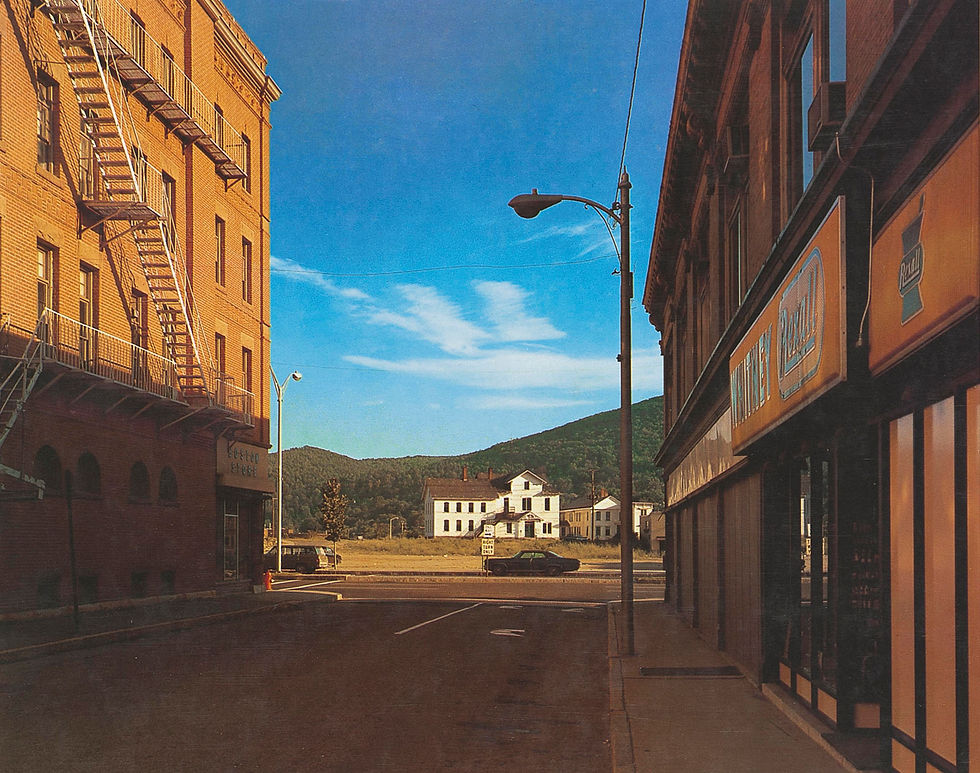
It was about this time that colour photography started to be taken more seriously. Proponents of the new topographics, like Stephen Shore (here in conversation with David Campany), were beginning to apply colour theory to photographs in the same way that artists always had.
The club has had previous discussions about colour theory that can be found here ...

This new way of looking at landscape gave rise to a more contemporary style where photographers were trying to say something about what they were seeing rather than simply recording it. The image on the left speaks of the futility of constructing a wall at the USA's southern border.
The image below, of the balloon seller amongst the ruins of Afghanistan gently mocks the pictorialists of the Victorian era with their romantiscised notions of the levant.


This David Roberts lithograph from 1846 has that romantiscised view front and centre ... it is a view of the ruins of Baalbeck in the Beqaa Valley near Beruit, Lebanon.
From the very birth of photography, the pictorialists believed that in order for photography to be taken seriously as an artform then it must ape the artworld. That it must take full advantage of 'artistic license' and not merely record what is infront of the lens. They sought to evoke emotion in an image ...
A well known early example would be the Flat Iron building taken by Edward Steichen ...

Not only is the Flat Iron a good example of pictorialism, it is also a good example of an Urban Landscape ... the building is firmly rooted in it's environment. In other words, the image has a good sense of place. All the images used so far in the article, be they traditional, topographical, contemporary, pictorialist or urban, have a strong sense of place.
Something that any good landscape photograph should have ... we've tackled this subject at the club in a previous discussion evening ...
When researching photographic pictorialism, there are a wealth of articles (presumably all quoting each other) that state that pictorialism was over by the first world war ... when it is, in fact, very much alive and kicking. There's an interesting article about pictorialism on the Scottish National Gallery website. And whilst it is slim on landscape images, it does provide a usefull insight into the subject. It also, and unusually, says that the style was still being used in the sixties although it was apeing vintage techniques. Well, lets bring it bang up to date!

To quote from the article in the last link, that the pictorialists"explored photography’s role as
an art form, prioritising beauty, mystery and atmosphere over accurate, scientific record" ... then the work of Hugh Millsom certainly fits the bill. He is not alone ... pictorialist photography, particularly within camera clubs is strong and widely practised.
An interesting technique to prioritise beauty, mystery and atmosphere is through multiple exposure, of particular interest is a technique known as 'in the round'.
A method of walking in a circle around something whilst photographing then putting all those images together ... the image below has enough detail in the background and just enough space around the tree itself to give it a sense of place.

Janina Wilde has written a good article about photographing in the round ... , full of technique and advice.
The technique can be transferred into the urban environment as in the work of Frank Machalowski ...

Defining urban landscape is the place where we, as a club, had the most difficulty ... It is probably best seen in these two images by Peter Mitchell. Peter spent over forty years documenting Leeds with his Hasselblad from the top of a stepladder that he carried with him whilst working as a lorry driver.
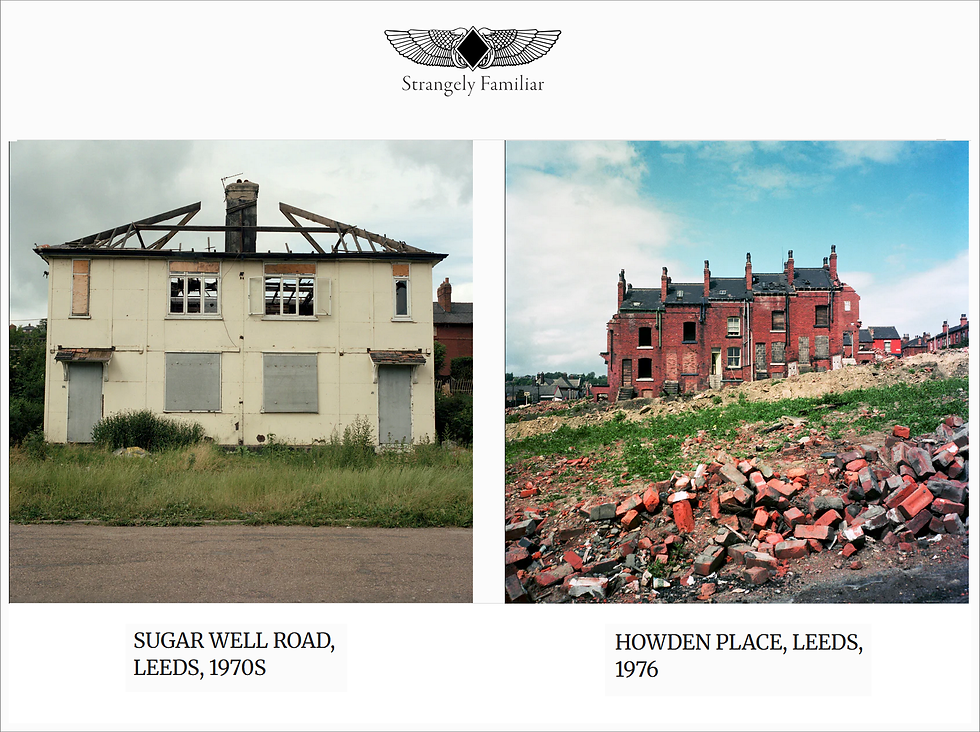
The picture on the right has the building itself filling the frame whilst the image on the right has more space around it, allowing the viewer to see the environment within which the building sits. The rubble not only provides foreground interest visually, but is also a portent of what will become of the buildings that are still standing. The rubble is part of the story of what is happening in the image.
The conclusion we came to was that the picture on the left was a photograph of a building, whilst the one on the right was an urban landscape. Further more, as the picture of Howden Place was also telling a story (it is a picture that is 'about' something rather than 'of' something) it could also be said to be a contemporary photograph.
When it comes to a contemporary urban landscape project, one of my favourites is Lee Friedlander's American Monument. Lee shot thousands of photographs of statues surrounded by the detritus of the modern world, all important when erected but now surrounded, and in some cases, overwhelmed by the way the world moves on ... two hundred and thirteen made into the finished book.

... and this brings us full circle, back to Ansell Adams, the traditional landscape photographer that we started with. It seems to me that when we are dealing with photographers work we are generally being a fed a rather curated view, be that by the photographer themselves, a photo agency or gallery, or the deceased estate or other interested parties. We said at the begining that the New Topographics exhibition was a reaction to the Ansell Adams view of the virgin west but Ansell didn't just photograph the bucolic ... we just don't see the other stuff very often ... blame the gatekeepers or their modern equivalent, the internet algorithm ...

What implications does all this have for club members when submitting images for a landscape competition? Simply put, here's the brief version...


